Nia Simeonova is a reporter intern at Dow Jones’s energy unit OPIS, covering carbon markets and hydrogen. She has previously published with The Times and Sunday Times. She was the Editor-in-Chief of Roar News, the 50-year-old student publication of King’s College London. Her experience covers everything from culture and education to politics and energy.


March 16, 2026 (Updated )
What is one asset journalism and comedy have in common? Naryan Branch. Starting out as an ITV News trainee, he is now a trainee production journalist at ITV West Country. His passion for sports opened up the opportunity to report on the Paris Olympics in 2024, and if he were not a journalist, Naryan would be a full-time stand-up comedian.
Whether running on the streets of Bristol or presenting in front of the camera, Naryan says a good journalist should remain curious about people and the world. We caught up with him at the Student Publication Association‘s National Conference 2025 to learn about the day in the life of a production journalist.
Tell us about your morning routine.
My morning routine is very varied because we have so many different shifts at ITV News. The earliest will be a 3am alarm that gets me in for an early shift to either produce the breakfast news or present it. The latest could be a lie-in that takes me into midday if I’m producing the late shift. So there are no two mornings that are the same at all.
What is your favourite breakfast?
Admittedly, I don’t have breakfast as much as I should, which is awful advice and this is why I’m not a nutritionist and a journalist instead! But if I did have anything, usually it’s some sort of pastry that fills me up. Again, no nutritional advice from me, please!
What is your favourite thing about working at ITV?
There’s genuinely so much to enjoy. It’s just that buzz of not knowing what’s about to come, but knowing that you’re going to be able to handle it, because you’re working with some of the best journalists in the region and even the country. That really keeps you excited.
I’ve had the privilege of working in other industries. A nine-to-five behind-the-desk job – I’ve done that life. But I needed a buzz and the ITV newsroom is the perfect place to have that buzz.
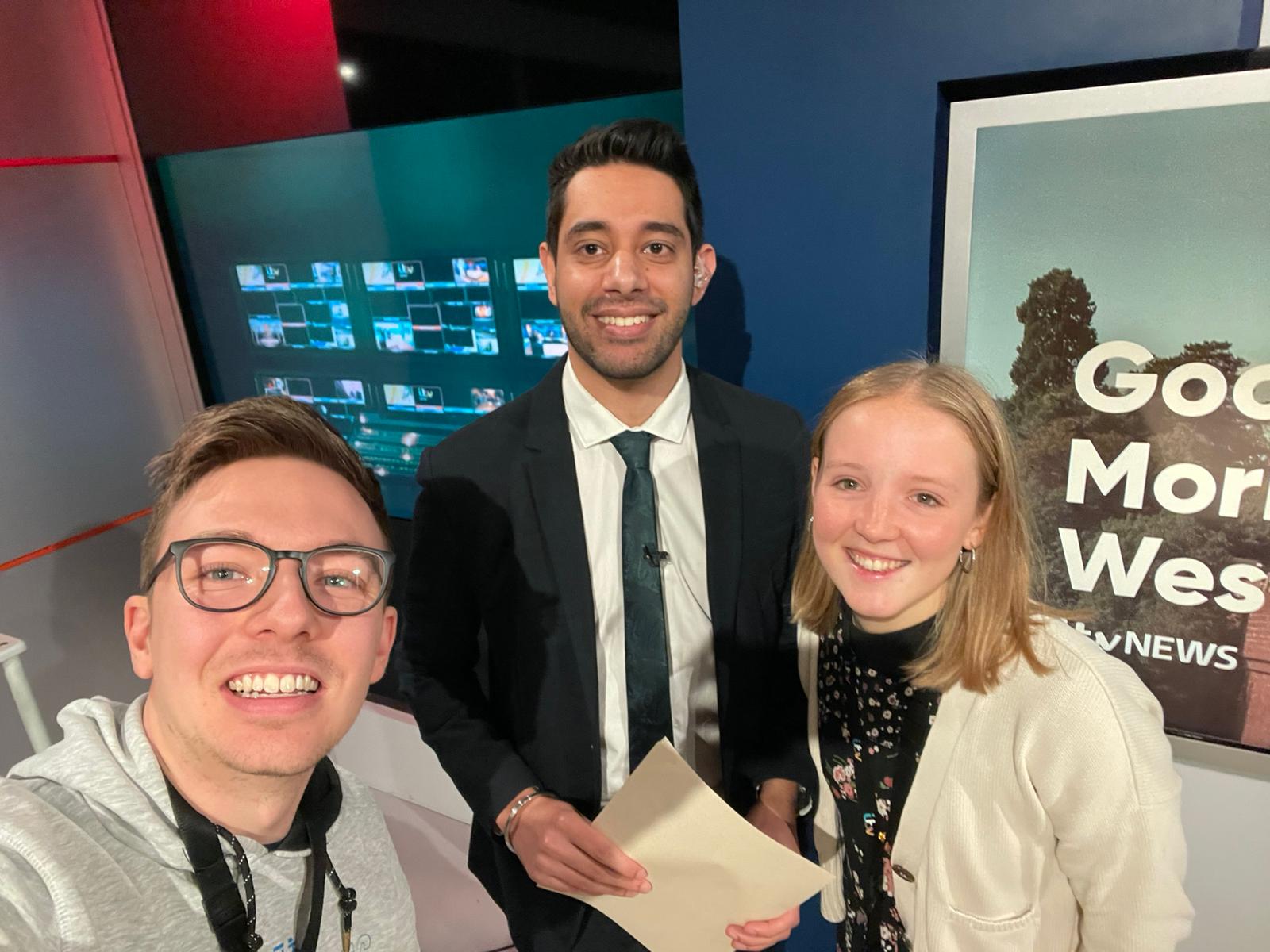
Tell us more about your role and the different desks you have worked on so far.
My role is as a production journalist. I came in on the traineeship where they train us up in many things – producing articles for the website, but also putting posts on various social media platforms and helping towards ITVX. There’s also reporting and planning for stories on the day or ahead of time for big events. You might be helping to get a statement from a hospital on a critical incident, presenting or working on your own special topics.
It’s a really multi-skilled job. It demands a lot from you, but it’s so interesting. And you can always choose to refine your skills in one area and go down that route.
What is your dream route within journalism?
That’s a really tough question! To get existential on it, in some ways I’m happy every day at work, so if the dream is to be happy at work, then maybe I’ve already found it!
But for a bit more of an honest answer, I would like a job that pays a bit more. I’ve enjoyed presenting recently, so if there was a role that came up to do more of that, then that would be fantastic. But I came in through sports, which I love. Some of my favourite things that I’ve ever done at ITV West Country have been in sports.
I’ve kept it nice and vague so that my managers can see this and think, perfect, that’s where he wants to go. So that’s my answer for that one!
If you could go on holiday anywhere tomorrow, where would you go?
Great question! I am turning 30 very soon and I would love to be out of the country for it. I love a sunny holiday. I don’t want to be anywhere that’s colder than the UK – I hate how cold it is in this country, please get me out of here as soon as possible! So somewhere nice and hot. I like a city break more than a beachy holiday. Morocco and Egypt seem to come up as suggestions for where to go, so maybe North Africa is the way forward.
Want To Delve Into The Daily Lives Of More Journalists?
We’ve interviewed dozens of people about their jobs, getting into the industry, and what they might do differently. Here are just a few:
• Nuala McGovern, BBC Broadcaster
• George Greenwood, Investigations Reporter at The Times
• Josh Barrie, Food and Drink Writer at The Standard
• Martin Booth, Editor at Bristol24/7
• Megan Wallace, UK Editor at the Gay Times
• Georgina Quach, Newsletter Editor at the Financial Times
• Dan Cody, SEO Editor at The Evening Standard
• Josh Sandiford, Journalist at BBC Midlands
• Louisa Wells, Head Of Podcasts, The Telegraph
• Carla Jenkins, Social Media Journalist, The Times Scotland
• Lukanyo Mnyanda, Scotland Correspondent at The Financial Times
• Laura Webster, Editor at The National
• Severin Carrell, Scotland Editor at The Guardian
What did you do before you became a journalist and how did it shape you?
Prior to journalism, I did teaching and transport planning. I loved teaching adults specifically. Originally, I was working as a recruitment consultant. I would go to job centres and encourage people to take on courses that teach them life skills to help them get a job. My colleagues thought that I was quite good at talking to people. So I thought I’d give teaching a go.
It was a really demanding job. I had classes of up to 35 people, so you have to deal with lots of different learning styles. But that is where it maps onto journalism very well – you get fascinated by your students and you get to shape the next chapter of their stories.
Some people who were unemployed for 10 or 20 years and then did a two-week course with us would get their first job in a decade. It’s unbelievably rewarding when you see the tangible impacts of someone growing in confidence because of something you might have said or taught them. It is a very noble profession and I have a lot of respect for teachers.
What I really love to do outside of work, though, is comedy. And if there was a way that journalism just disappeared, then that would be the route to go. I would love to do something that makes people laugh.
How are being a journalist and being a comedian similar?
Oh, I tell you what, there are plenty of similarities. We learn how to write and how to write tightly. Particularly for TV, you have to be punchy and as economical with your words as possible. I think a lengthy joke is the most boring joke you can possibly listen to, so good punchy jokes are similar to punchy news.
How to present yourself and how to be on stage – it’s actually very similar to doing comedy. It’s amazing how much one maps onto the other. There are days when I feel like I’ve worked well as a journalist, and because of that, I’m in the mood to write jokes. It feels like it’s two sides of the same coin.
Do you have any hacks on how to establish a connection with people?
It’s hard to come up with a hack because I’ve always been quite interested in what people are like, how they think and move, what interests and motivates them. You don’t know what story they’ve got.
We all know that person whom you’ve spoken to for five minutes, thinking there’s nothing going on there. And then they hit you with that one fact or story and you’re like, oh my God, I did not see that coming! Every single person you meet is potentially just one or two minutes away from revealing that to you.
So if you go into it thinking that every single person is unique and far more interesting than we are, then that’s your hack. That’s what gets you connected.

"My number one bit of advice would be to be as proactive as possible. It doesn't matter whether you're shy or really outgoing. If you've got an interest in people, just go out there and have a chat. If there's an opportunity you want, phone someone, email someone, be interested in the world, and talk to people."
Naryan Branch, production journalist at ITV News
Is there a story that has stuck with you throughout your time as a journalist?
A story that we had recently on ITV News (I think it was a world exclusive) was about two people who had the biggest collection of lawnmowers – about 1,500 –and that was one of those when you think, that’s very regional news, but also captivating television!
There’s one I remember of a woman who let her parrot out the house and it got stuck up a tree. Then her sister went to get it and they ended up calling the fire brigade because then there was a woman and a parrot stuck up a tree. And that’s classic regional news. It’s why we love the industry so much.
One thing I’ve been really proud of, though, was working on the 2024 Paris Olympic Games. I got to meet so many cool athletes who made me feel very physically inadequate – great motivation for the gym! But they were just wonderful, very down-to-earth people who try so hard and care about the community and their sport. Team GB’s rowers, particularly – it was an absolute honour to meet all of them. So that’s a real career highlight for me.
What is your advice for journalists who might want to follow in your footsteps?
My number one bit of advice would be to be as proactive as possible. It doesn’t matter whether you’re shy or really outgoing. If you’ve got an interest in people, just go out there and have a chat. If there’s an opportunity you want, phone someone, email someone, be interested in the world, and talk to people.
Another bit of advice that I also heard was to just ask that extra question. When you think something is finished, ask one more question and you just don’t know where that might lead.
Whether you’re trying to get a job or find a story out, just go for that and back yourself. It’s a tough and competitive industry. So that means you have to be a little bit more resilient. It might just take a bit of time.
Finally, what do you do to wind down after work?
I love my downtime. A lot of mine is actually spent in solitude. I read a fair amount, I go to music and comedy gigs. I like to perform comedy, too. I also tend to run. If I’ve had a hard day at work or a good day at work, I’ll just run around Bristol. So, if you see a guy running with the worst posture in the world, it’s probably me! You always need to wind down after work, whatever you do, but I’m always excited to get back again.