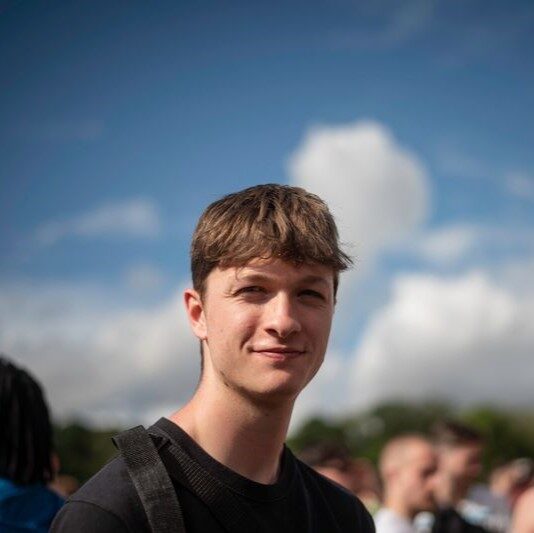
Benji Chapman is a freelance copywriter and journalist, who is music editor for the University of Bristol’s student newspaper Epigram.


March 30, 2026 (Updated )
From writing about underground music scenes to taking down AI music and the cultural traditions of overlooked communities, Isaac Muk is skilled at discovering stories off the beaten track. Currently working as digital editor at HUCK Magazine and previously writing for for Crack Magazine, Mixmag, i-D, Dazed, the Guardian, and more, he has his finger on the pulse of both politics and pop.
We caught up with Isaac at the Student Publication Association‘s National Conference 2025 to learn about the day in the life of a digital editor and culture writer.
How do you feel the digital media landscape should be responding to problems regarding a decline of readers’ attention spans?
That’s really interesting because I think that digital media can be very focussed, a bit too much focus, on the numbers. As an editor myself, if we put out a piece, the first thing we check on it is ‘oh did that do well’, you know, ‘did we get more eyeballs on it than that piece’, and then if we did, why did we get more eyeballs.
Sometimes I think that can distract from actually just doing something really well, like sometimes the more niche things are more interesting, maybe to a smaller number of people, but just because it might not have the numbers doesn’t make it any less valuable.
Want To Delve Into The Daily Lives Of More Journalists?
We’ve interviewed dozens of people about their jobs, getting into the industry, and what they might do differently. Here are just a few:
• Serafina Kenny, Freelance Health Writer
• Naryan Branch, Production Journalist at ITV News
• Nuala McGovern, BBC Broadcaster
• George Greenwood, Investigations Reporter at The Times
• Josh Barrie, Food and Drink Writer at The Standard
• Megan Wallace, UK Editor at the Gay Times
• Georgina Quach, Newsletter Editor at the Financial Times
• Josh Sandiford, Journalist at BBC Midlands
• Louisa Wells, Head Of Podcasts, The Telegraph
• Carla Jenkins, Social Media Journalist, The Times Scotland
• Lukanyo Mnyanda, Scotland Correspondent at The Financial Times
• Laura Webster, Editor at The National
• Severin Carrell, Scotland Editor at The Guardian
So, I think that an important thing for journalists and editors is to be able to think more about who they’re trying to appeal to. So, maybe having a smaller readership that’s less focussed on numbers might be more valuable to your publication than something that goes semi-viral if you know what I mean.
And I think that sort of manifests in the way a lot of new media companies are coming through, like Vittles. They’re behind a paywall, so numbers are naturally gonna be smaller, but what they do is really specific and provides a lot of value to its readers.
What was the moment during your career where you thought: this is it, I’ve made it as a full-time journalist?
Ooh interesting. I don’t think I’ve ever thought that to be honest. Imposter syndrome is a very real thing which I think a lot of people have, I think even people who are like really quite entrenched in the industry. And I think that’s okay.
Gabriella de la Puente from The White Pube once said to me ‘you’re a writer until you stop writing’, and it’s true basically. Everyone is a writer and as long as you do it and write, then you are, and it’s good to remind yourself of that sometimes. There’s never been one moment where I think I’ve made it.

"Imposter syndrome is a very real thing which I think a lot of people have, I think even people who are like really quite entrenched in the industry. And I think that’s okay. There’s never been one moment where I think I’ve made it."
Isaac Muck, digital editor at HUCK Magazine
I think especially in the media landscape we live in now, where anyone can lose their job at any point, and I got laid of from Crack Magazine, and you know what, that’s okay. It wasn’t anything to do with me, and you have to remind yourself of that when you get laid off.
An American writer, Ilana Kaplan, she put that tweet out that said something like ‘you go into every job in journalism expecting to lose it’, and you know what, you should, and that’s okay.
What is your favourite type of music to listen to while you’re working or writing?
This is shocking as a music journalist but actually I don’t listen to music when I write. It’s funny because obviously you get into music journalism because you love music, and you wanna write about it and you wanna talk about the things that you’re listening to and that sort of thing.
Often you don’t because you’re so surrounded by it all the time, and often I do sit down and listen to promos, and listen to music, and talk about what I’m gonna write and stuff. But when I’m actually writing I don’t. So, I guess a lot of the time it means that I don’t listen to as much music as I used to in some ways.
But yeah, if I was to have to choose, it would probably be some quite fast trance just to get my brain juices flowing.