Tara Russell is a freelance journalist and lifestyle editor at The Indiependent. She will join The Guardian’s Positive Action Scheme internship and will begin her NCTJ training at News Associates in autumn 2025.


August 12, 2025 (Updated )
“Nothing about us, without us,” says Māori journalist Jamie Tahana, whose writing on Indigenous affairs has been published by The Guardian and New Zealand Herald. As journalism reckons with ongoing imbalances in representation and colonial legacies, Jamie’s statement encapsulates deeper questions at the heart of journalism today: whose voices are centred, whose voices are excluded, and who has the authority to tell a community’s story?
Indigenous people have long been spoken about, rather than with, in traditional media. And, even when they are spoken with, they rarely lead the conversation. This erasure is not incidental — it’s systemic.
By contrast, Indigenous storytelling not only offers an alternative method of reporting, but it also fundamentally rethinks what journalism is — and whom it serves. Its essence, rooted in oral history, relational accountability, and community knowledge, confronts the imbalance in representation and offers critical guidance to stories that involve and matter to Indigenous communities.
Stella Paul, a North-East Indian journalist who has written for Inter Press Service and Global Issues, puts it plainly: “Storytelling, for Indigenous people, is a way to reclaim their voices, correct stereotypes, and create their own media spaces to speak for themselves.”
This reclamation is not about inclusion for inclusion’s sake, but about sovereignty over narrative. It asserts presence, refuses erasure, and challenges the structures that have long spoken over Indigenous voices. It’s a reminder that Indigenous peoples are not disappearing into history. They are here, enduring, and resolutely present.
For journalism to genuinely decolonise, it must move away from Eurocentric assumptions of neutrality and objectivity. As decolonisation expert and freelance journalist, Dan Hastings, explains: “Decolonisation means decentring the West.”


Dan Hastings (L), is a freelance journalist and decolonising trend forecaster at L:SN Global, and Jamie Tahana (R) regularly contributes to the Guardian and the New Zealand Herald.
This isn’t merely a political gesture — it’s a conscious psychological shift. Western journalism often imposes external frameworks onto complex issues, flattening cultural nuance into digestible news copy. By contrast, Indigenous storytelling uplifts community knowledge, continuity, and responsibility.
Dan, who has written for British Vogue, The Independent, The Business of Fashion, and more about intersectional Indigenous issues, continues: “Passing the mic is not just symbolic. It’s about creating space where Indigenous voices shape the narrative from the start, not as an afterthought.”
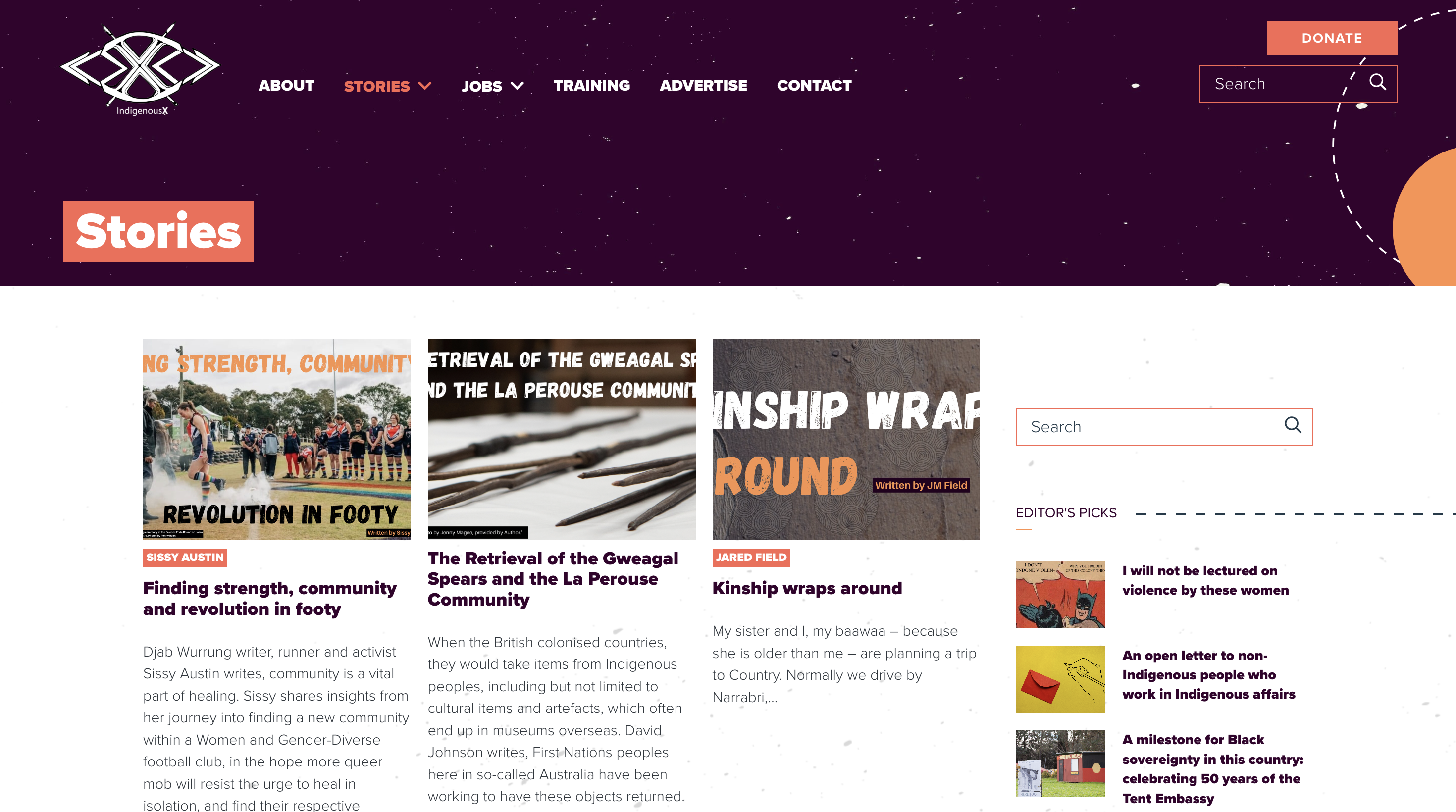
Platforms like IndigenousX, where Indigenous Australian representatives from a wide variety of communities take over the platform each week, exemplify what’s known as a rotating-host, community-led model. This approach hands full editorial control to a new Indigenous voice each week — allowing storytellers to speak directly, rather than being filtered through typical media channels. It’s not ‘reporting on’ communities; it’s led by them. There’s no gatekeeping, no rewriting to suit dominant narratives — just unmediated perspective.
Such models offer a powerful lesson to traditional media: true equity comes not from quoting marginalised voices, but by enabling them to drive the story — on their own terms.
The contrast between Western and Indigenous journalism lies not just in content, but in worldview. Western models tend to favour the individualistic, sensational, and conflict-driven narratives that bring in readership numbers. Indigenous journalism, by contrast, is relational — rooted in shared responsibility, respect, and collective memory.
Articulating an example of this, Jamie explains: “There was a real dissonance between the realities of Māori and what the rest of New Zealand thought of their country. There are so often stories that do not feature us at all, or are about us but do not speak to us or even attempt to understand where we’re coming from.”
This gap between perception and lived reality is particularly stark in how Indigenous issues are framed in mainstream outlets. Jamie recalls how Māori are often only visible in media under a specific set of derogatory conditions: “You’ll only ever see a Māori on the front page of a paper if they’re mad, bad, or sad.”
Decolonising journalism isn’t about perfect reporting — it’s about continuous practice that everyone takes part in. Jamie explains: “If we’re going to break Indigenous storytelling out of the ghetto, it takes everyone to do their bit.” For non-indigenous editors and journalists across global media, this means:
• Examining positionality: Be transparent about your perspective and its limits;
• Practising relational reporting: Build long-term, respectful relationships with communities;
• Creating editorial space: Don’t just feature Indigenous voices — let them lead;
• Respecting Indigenous knowledge: Treat cultural expertise as expert knowledge, not anecdotal colour;
• Committing to long-term change: Move beyond one-off features to structural support and staffing diversity.
Meanwhile, Stella envisions a future where Indigenous leadership in media is no longer the exception: She says: “My vision for Indigenous journalism is a future where Indigenous storytellers are offered equal opportunities to lead their own narratives, preserving culture and shaping public understanding on their terms.”
This vision — one of respect, agency, and shared responsibility — offers a blueprint not only for better journalism, but for a more honest and inclusive media future.
One of the clearest examples of this narrative disconnect came in 2019, when coverage of the climbing ban that was introduced in Uluṟu, Australia, went global. After decades of advocacy by the Aṉangu people, the sacred site was finally closed to climbers. However, media headlines such as, ‘Tourists flock to Uluru for last chance to climb ancient rock’, predominantly centred the frustration of visitors over the long-sought triumph of Indigenous custodianship.
Despite the land having been officially handed back to the Aṉangu in 1985, coverage framed the ban as an imposition instilled by the government, sidelining Indigenous sovereignty and the profound spiritual significance of Uluṟu. This reduction of Indigenous rights to an inconvenience for outsiders illustrates the persistence of colonial framing in supposedly objective reporting.
The responsibility doesn’t just lie with field reporters — editorial decisions at a higher level can and do shape the contours of public discourse. For Stella, one of the biggest challenges isn’t sourcing stories — it’s reaching publication with the original story still intact.
She explains: “The biggest challenge, I would say, is editorial censorship that alters a story to fit dominant views […] or, sometimes, editors just ‘kill’ the story because they feel the narrative may be way too sensitive for their audiences.”
Even when Indigenous journalists report on systemic issues beyond the expected beats of protest or tragedy — such as climate resilience, local economies, or tech innovation — editorial teams often lack the imagination, or the will, to back these stories. Stella continues: “There are Indigenous stories related to technology, trade and finance — but there is hardly any interest in telling such stories. Changing this mindset is hard.”
Stella is careful to make sure her storytelling is not only factual, but emotionally and culturally truthful. “Balancing urgency with depth ensures the story is honest, respectful, and meaningful — not just attention-grabbing,” she adds.

Too often, Indigenous stories are filtered through a trauma lens — reinforcing stereotypes rather than reflecting the complexity of lived experiences. A rare and powerful counter-example emerged in the Indigenous coverage of the destruction of the Juukan Gorge in Western Australia, when mining group Rio Tinto demolished a 46,000-year-old heritage site.
While traditional publications focused largely on the corporate fallout, Indigenous outlets and journalists framed the event as a deep cultural loss, drawing on oral history, symbolic language, and ancestral knowledge to contextualise the destruction.
This approach reflects what many Indigenous journalists see as the essence of their work: storytelling not as resistance, but as a honesty.
“It’s just standing up and saying, ‘We’re here. This has been overlooked. Here are our stories. Here are our people’,” Jamie explains.
Indigenous storytelling is an exercise in truth-telling as well as in representative journalistic practice. It doesn’t always centre balance in the conventional sense, but strives for justice, context, depth, and recognition of historical harm.
As non-Indigenous journalists engage with Indigenous stories, collaboration must replace extraction. “I would strongly suggest colleagues… avoid tokenism, and prioritise Indigenous perspectives and stories on their own terms,” advises Stella.
It also requires confronting the emotional labour Indigenous journalists often carry alone. As Jamie notes: “How can you accurately reflect the country or properly reflect how issues or policies affect people if you’re a newsroom full of private school kids?”